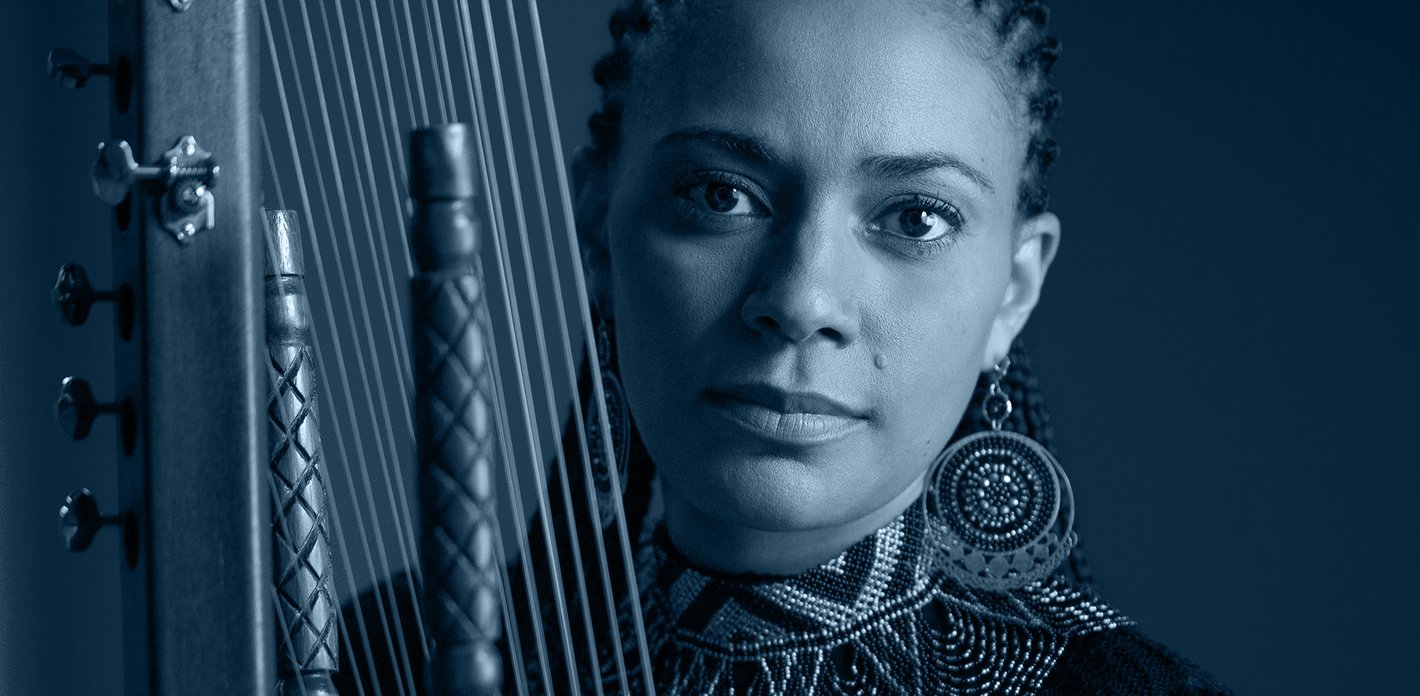
Reimagining tradition—and giving it a voice of its own: this is the artistic principle of Sona Jobarteh. Single-handedly, the Gambian-British musician has opened up the playing of the traditional West African kora—a 21-string bridge harp long considered an exclusively male domain—to women. She introduces her instrument to the Elbphilharmonie on April 12, together with her band and her son Sidiki. In the podcast, she speaks about motherhood, the passing on of values, the search for one’s own path, and the question of how tradition can give rise to the future.
Sona Jobarteh, born in London in 1983, comes from a griot family with a history spanning over 700 years. Griots were once storytellers, musicians, and cultural chroniclers at West African courts—highly respected for shaping identity and conveying values. Through her singing and the kora, a West African long-necked harp, Jobarteh continues this tradition while also evolving it.
Educated at the Royal Academy of Music and the Purcell School, and with a degree in African Studies, she uniquely combines Western and African influences. Despite early doubts about the international potential of a traditional instrument, she has established herself worldwide—as a musician, composer, and a voice for a new West African sense of identity.
Her commitment extends far beyond the stage: in The Gambia, she founded a school that brings together Western education with African history, culture, and craftsmanship. Her aim is to empower young people to think independently and to take responsibility for the future of their country. Her son Sidiki, himself a musician, is also part of this journey.


