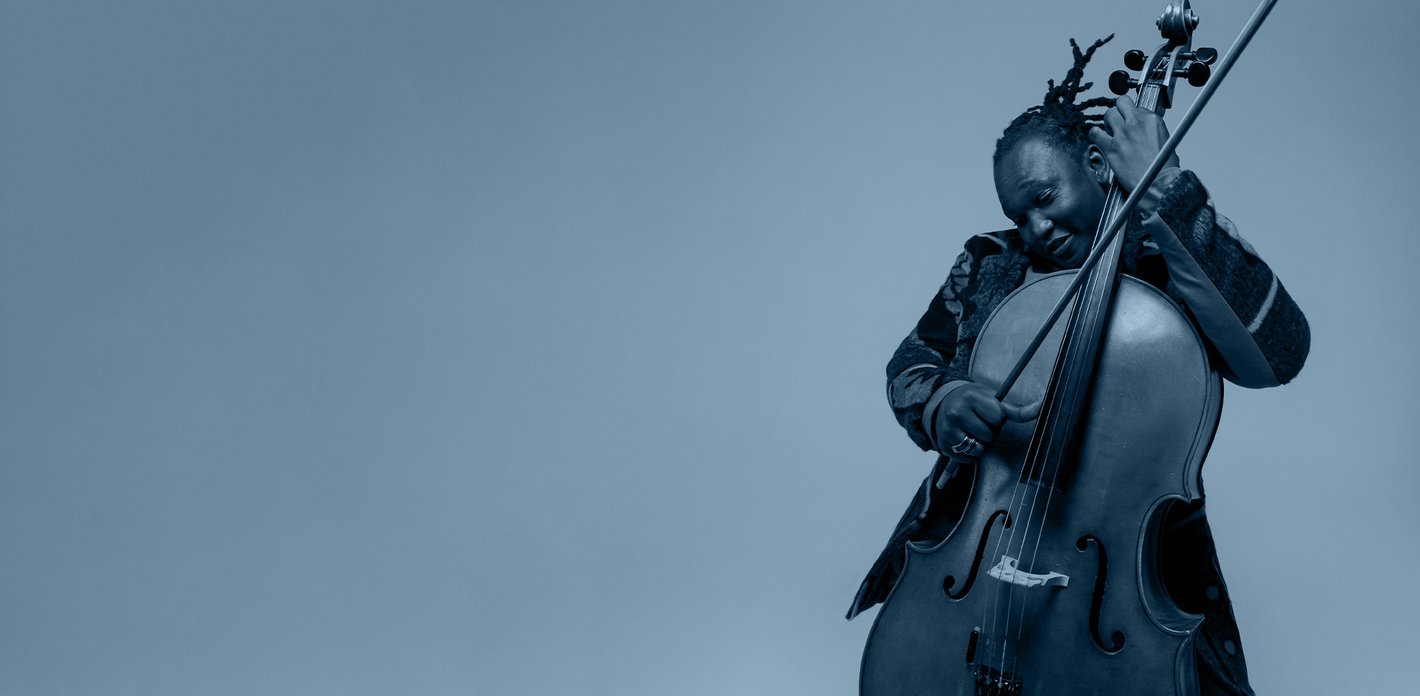
The whole world currently finds him really amazing. But leave off why? However, the young classical star Abel Selaocoe knows a tried and tested method: cleaning the kitchen floor at home. This provides grounding, it regulates body, mind and soul and it is wise. Because all that adrenalin and endorphins, triggered by making music in front of people who are overwhelmed with joy, can quite discombobulate anyone.
In this podcast with the Elbphilharmonie, Abel Selaocoe, the charismatic cellist and singer from South Africa, based in Manchester, also tells us about his singing, his 15-month-old daughter and how completely differently she is growing up than he did. He talks about his parents, who still live in the same township where he grew up, and about the pervasive soundscape there where homes have thin walls and you can hear everything. Of course, we also talk about his brother Sammy, who is eight years older and to whom he owes pretty much everything in terms of his musical development.
Abel Selaocoe is what you call a fisher of men. As once the wonderful singer Bobby McFerrin did, he sooner or later moves each audience into an extraordinary state in which it steps out of its traditional role as a group of passive consumers and becomes an impromptu creative collective. One is tempted to attribute this gift to Selaocoe’s ancestry, to his modest beginnings in a township south of Johannesburg borne by his family and his entire neighbourhood and to the unusual career he has made from there. He went his way through the institutions of classical music training, but he has never let anyone deter him from his unconventional approach to playing music.
As a black musician on the classical music scene largely dominated by nonblack artists, Abel Selaocoe is deeply familiar with the persistent experience of being different. It stretches back even further for him, however. Because as a scholar from South Africa, hardly had he come to England as a teenager than he had to find his way and learn to assert himself at a college amongst offspring from the white upper class.
What has sustained him through everything to this day perhaps more than the encouragement of the audience and the blessing of his daily routine is the influence of his ancestors. They are in many ways present for him, on and beside the stage. But the spirit animal of his tribe in South Africa is the piri, a kind of wild boar. The piri, according to Abel Selaocoe, teaches respect for tradition – and specifically encourages one not to repeat the mistakes of one’s ancestors. This balance should also be really helpful for grounding you in life.


