Text: Tom R. Schulz, November 2025
There is a variety of reasons why Hamburg occupies an unshakeable place in the limbic system of Brad Mehldau, who has been touring the world with his improvised music for decades. The most distinguished of these is Johannes Brahms. Mehldau loves the aloof composer, a native to Hamburg in his day, for the harmonic richness of his music, for the dense, powerfully subterranean flow of emotion concealed in a characteristically North German way. Brad and Brahms are mots qui vont très bien ensemble, like Michelle and ma belle in Lennon/McCartney. The latter weren’t born in Hamburg like Brahms, but they famously came of age in the city’s St. Pauli district. Mehldau also loves the music of the Beatles. He has studied it just as intensively and turned it inside out as he has Brahms’ piano works, intermezzos, songs and symphonies.
Born in 1970, the American has been gathering compelling reasons for a detailed portrait of Hamburg since his acclaimed trio debut in the Laeiszhalle Recital Hall in 2009. He has since performed there solo and appeared in duo concerts with singer Anne-Sophie von Otter, saxophonist Joshua Redman, and mandolin virtuoso and singer Chris Thile.
No sooner had the Elbphilharmonie opened than Mehldau became the first pianist ever to perform solo in the Grand Hall, two days before the first major name from the world of classical music. The new concert hall had thus signalled clearly that it would not be considering jazz any less important than classical music. This remained a manageable risk, as Mehldau himself considers classical music no less important than jazz. With his courageous solo performance in the brand-new hall, whose acoustic properties for solo piano had yet to be tested, and with each subsequent appearance at the venue, Mehldau cemented his reputation in Hamburg as the world’s finest jazz pianist, whatever one may think of such labels.
»Reflektor Brad Mehldau« :12.–15.3.2026
The jazz pianist Brad Mehldau in all his artistic facets: as a soloist, in a duo, with big band and an orchestra – he shows himself to be a gifted interpreter, composer and improviser.
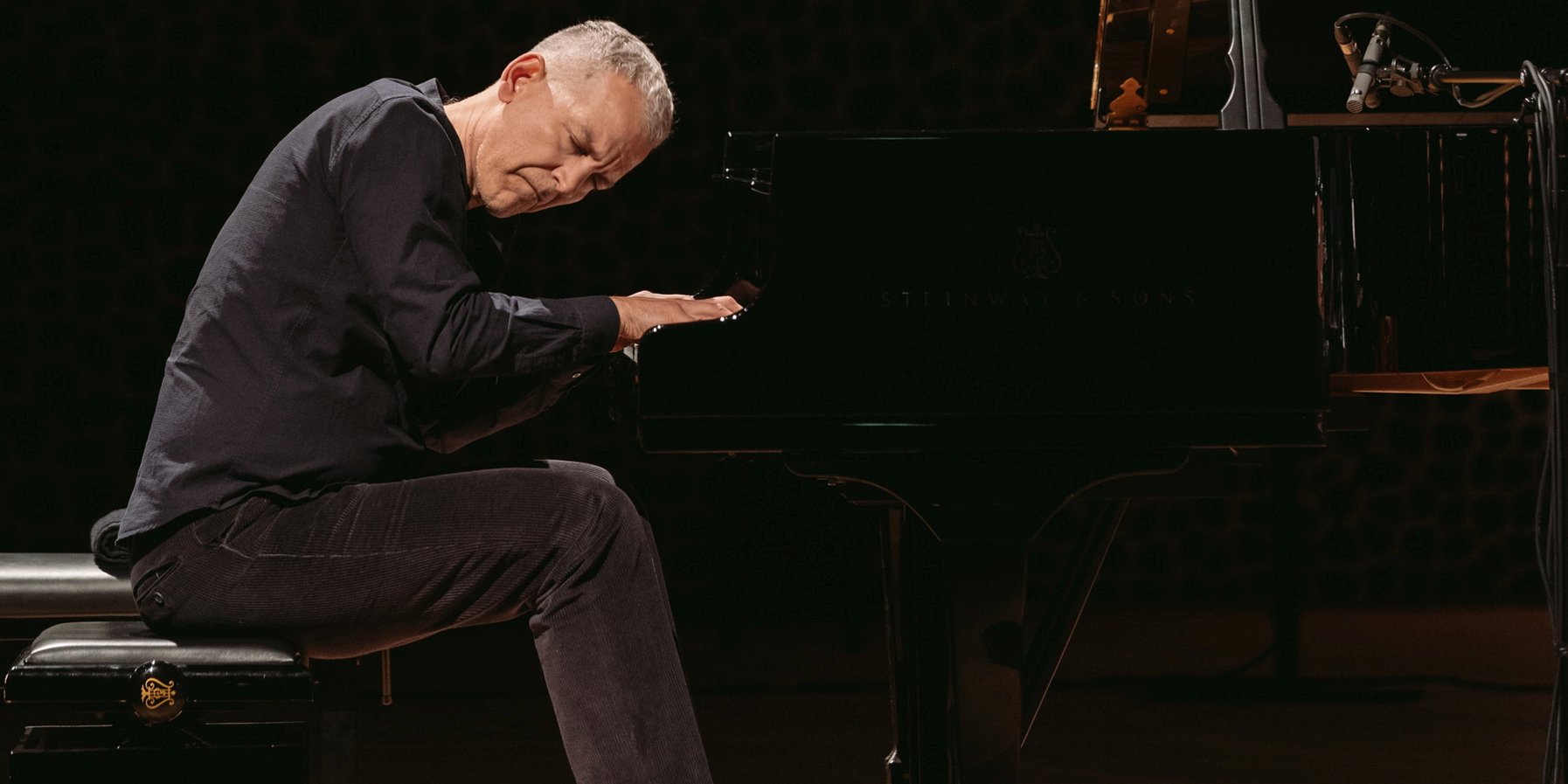
A trio concert on 12 March 2020 remains particularly unforgettable. The evening in the Grand Hall with Mehldau and his colleagues Larry Grenadier (bass) and Jeff Ballard (drums) was shaded in those tones of blue that envelop the heart and soul when a song suddenly yet quietly shifts from major to minor. Mehldau loves this effect. The musicians were suddenly faced with the prospect of being the last ones to turn off the lights in the Grand Hall, as it were – with the first lockdown of the pandemic just around the corner. The hall was already only half full. Many who had bought tickets had stayed home for fear of infection or had given up hope that the concert would take place at all. Then from 13 March onwards that year, it was indeed over for many months ahead.
As a final encore, the Mehldau Trio played a wistful yet upbeat version of the musical number »My Favourite Things«, long since a jazz standard. The song is in three-four time and has cheerful lyrics in its original form, listing all kinds of unrelated things that the protagonist of the musical is particularly fond of and recommends thinking about when, as the chorus says, the dog bites, the bee stings, and you’re feeling sad. Because then you’ll feel better straight away. Mehldau, (also) a thinker at the piano, is far too perceptive to have chosen this comforting jazz waltz as a farewell purely by chance. For some who were present that evening, the song will have accompanied them silently through the days and weeks that followed.


After many more concerts at the Elbphilharmonie – including performances of his own songs sung by the British tenor Ian Bostridge in the Recital Hall – Brad Mehldau now accepts the venue’s invitation to curate a »Reflektor« festival in the 2025/26 season according to his own artistic vision. In doing so, he unmistakably gives reference to the Elbphilharmonie’s central purpose as a classical concert hall. Together with the Hamburger Camerata, he is set to perform his two works for piano and orchestra, which carry the spirit of Gershwin’s »Rhapsody in Blue« into the 21st century in a lively and independent way. His Hamburg idol is also present in spirit with »Variations on a Melancholy Theme«; in this piece, Mehldau writes, he imagines Brahms waking up one morning with the blues. Mehldau entrusts his own compositions to the exquisite arranger Darcy James Argue for big band arrangements; with long-time bass buddy Christian McBride, he is putting together a duo concert that promises to be a celebration of highly intelligent, virtuosic swing. And, of course, there is also a solo recital – though unlike usual: »14 Rêveries« is the title of a programme consisting largely of composed works for solo piano, allowing Mehldau to focus even more closely on interpretive subtleties, as if they were pieces by Schumann or Brahms. Yet they are all entirely his own.
Flavour: bitter almond
In »The Long Goodbye«, the final chapter of his recently published book »Formation. Building a Personal Canon Part One«, Mehldau devotes three sparse paragraphs to a less pleasant souvenir of Hamburg. It recalls the period, 30 years ago, when he was addicted to heroin. It is heart-breaking to read: heroin and jazz – wasn’t that long gone? One thinks of the many addicts from jazz’s highest ranks in the forties, fifties and sixties – Charlie Parker, Philly Joe Jones, Billie Holiday, Miles Davis, Chet Baker, Bill Evans and all the rest of them. We know much about their drug use, but almost nothing first hand. None of the lucid addicts of jazz has testified to addiction as relentlessly and precisely as Brad Mehldau does in his book. In the foreword, he stresses emphatically that heroin addiction did not make his music any better or deeper.
Nevertheless, the demons of self-destruction, with which he struggled in a dance as devoted as it was exhausting until his successful withdrawal in 1996, haunt Mehldau’s playing in an unmistakable way. Beneath his hands – always so close to the keyboard, as if each of the 88 keys were one of those metaphorical straws a drowning man clings to – individual notes or chord progressions can suddenly sound desolate beyond measure, bottomlessly sad, lonely, overshadowed by pitch-black darkness. Again and again, the silence into which one willingly sinks to hear his improvisations suddenly becomes something it cannot actually be: even quieter. At times he also exposes himself to the opposite extreme of the emotional scale. It is then that one senses inner struggles carried through to the bitter end. It remains a mystery how confidently Mehldau is able to place his musical and pianistic mastery in the service of such emotional extremes. »I don’t know anyone,« says Chris Thile of his musician friend, »whose path from the mind to immediate expression is as unadulterated as his.«
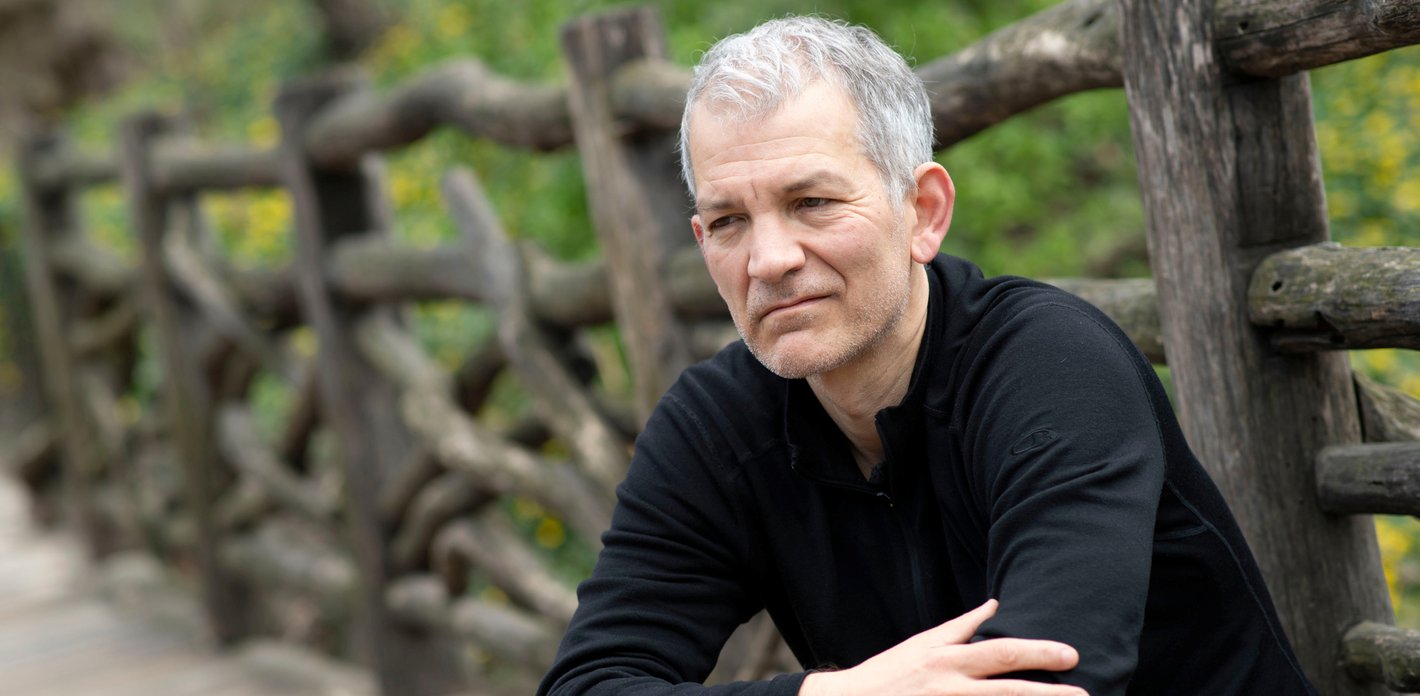
After a certain age every man is responsible for his face, writes Albert Camus. The sentiment casts a brutally clear light on one’s contribution to what happens in adult life. It is often brutally unfair. What if the marks left on a face originate before a person can take responsibility for themselves? When you look at photos of Brad Mehldau, or at him in person, as he plays the piano with a furrowed brow and the corners of his mouth turned down, leaning so deeply into the keyboard as if he were about to disappear into it, then you think you see reflected in this sight not only the suffering of his young adult years but also the primal wound of the rejected child who, despite the loving acceptance of adoptive parents, can only guess why his biological parents gave him up: this child must have been profoundly unlovable. Precisely that born loser that his charming elementary school classmates in Bedford, New Hampshire, soon labelled him. Growing up is rarely a walk in the park. For Brad Mehldau, it tasted more like bitter almond.

But then there was Mel Subulkin, his first piano teacher, an apparently shrewd musician of the hotel pianist variety. He encouraged his young pupil to embellish the first pieces he learned to play with inventions of his own. Improvisational freedom thus opened up for him early on, as did the sense that one’s inner world is the true resonance chamber of music – especially for involuntary loners like him. Brad’s first childhood idol was Billy Joel, who sang his own songs and accompanied himself on piano with catchy chords as the »Piano Man«. As a boy he listened to his music and that of many others on his radio alarm clock, in the car radio and during the summers of his childhood on the lifeguard’s transistor radio at the local outdoor pool. »I can still smell the chlorine and feel the hot cement and the warm sun when I hear those songs from that time«, Mehldau writes. »I can feel the sweet anticipation in my belly as they begin.«
Billy Joel: Piano Man
In the 1970s, popular music sprouted in many exciting directions at once. Woodstock had just revealed the full richness of a new generation’s sound. The Beatles weren’t quite history yet and exciting new music kept emerging, from the US, England and Canada: Led Zeppelin, Deep Purple, The Eagles, The Grateful Dead, all the great singer/songwriters. Prog rock bands like King Crimson, Genesis, Rush, Emerson, Lake & Palmer and Yes. Funk, soul and R&B from Stevie Wonder to Marvin Gaye. And jazz attempted to regain its interpretive authority over popular music through its fusion with rock music. And jazz sought to reclaim interpretive authority over popular music through its fusion with rock music. Until finally, at the end of the decade, punk and new wave reduced everything that had become too well-established and fussy to rubble and ashes in a joyful rage.
For people with a pluralistic taste in music, there was no better decade. This inexhaustible source material from early musical experience continues to nourish Mehldau’s work today, lending absolute authenticity to his interpretations of pop songs – no matter how ingeniously he recharges the originals rhythmically, harmonically and melodically, filleting them with the jazz musician’s razor-sharp tools. Whether he’s reinterpreting Lennon/McCartney or Nirvana, Nick Drake or Radiohead, or most recently honouring Elliott Smith (»Ride Into The Sun«), Mehldau always delves deep into the soul of these songs. Their emotional power is also in good hands with him.
A rare double talent
After the Mehldau family moved to West Hartford, Connecticut, Ruth Hurwitz – piano teacher number two – provided the talented, motivated ten-year-old with the technical grounding needed to grow with pieces from the classical repertoire. His progress must have been rapid. Summer courses brought encounters with other young musicians, with high-end classical music, and with ground-breaking records by John Coltrane and Miles Davis. At 18, he moved to New York City, receiving a scholarship to study jazz at the New School for Social Research in Manhattan. Mehldau describes the jazz scene of his new home from the late 1980s onwards, in which he soon played a role himself, in vivid and personal detail. At the same time, you learn a lot about jazz in general and its recent history in particular.
As the author of this book, to be followed someday by Part Two, Brad Mehldau reveals – just as in the liner notes and essays on current events he publishes on his homepage – a rare and remarkable dual gift for music and writing. His texts make clear what renders his improvisational art so special: it too arises from a rigorous intellectual and emotional search for a resilient artistic truth, far removed from the supposedly fleeting art of the moment often associated with improvisation. What we read and hear from him springs from the same searching spirit, never satisfied with the obvious. Brad Mehldau is perhaps the first musician in jazz to have mastered the art of the essay on his computer keyboard as well as on the piano keyboard.
This article appeared in the Elbphilharmonie Magazine (issue 01/26)


