Philharmonic Chamber Music Recital
Works by Johann Strauss II, Arnold Schoenberg, Gustav Mahler and Karol Szymanowski
This concert has already taken place!
€11
|
15.40
|
22
|
30.80
This concert has already taken place!
€11
|
15.40
|
22
|
30.80
-
Doors open 10:00
-
Start 11:00
-
Interval
-
End ca. 13:00
Vienna in the vanguard of Modernism
Things get very lively in this chamber concert, just as they did in Vienna at the beginning of the 20th century: Inspired waltz sounds are met with the joyful experimentation of the Second Viennese School, and Late Romanticism meets Young Poland. Diametrically opposed composers, each with their own sound language, yet all wrapped up in the spirit and expression of the Fin de Siècle.
And the expression here hints at more than just the impending shift in calendar date from the 19th into the 20th century. The mood at the turn of the century is a turbulent one: Romanticism is ending and with it comes the decline of a musical perspective that has dominated for the past 100 years. Suddenly, new perceptions, ideas and visions were emerging. And new styles and movements springing from these: Symbolism, Art Nouveau, Impressionism, Aestheticism and, last but not least, the Avant-Garde.
A period of contradiction – and surprises. Who would have thought that Anton Weber, one of the leading avant-gardists of his time, was a great refiner of salon music? His arrangement of »Der Schatzwalzer« by Johann Strauss was not just the result of his own musical interest. Arrangements like this were primarily intended to ensure the survival of Schoenberg’s »Verein für musikalische Privataufführungen« (»Society for Private Musical Performances«).
The fact that art is sometimes subject not only to artistic ideals but also to commercial constraints was something Arnold Schoenberg was forced to realise very early on. That is why he took his compositional destiny into his own hands with the founding of the »Musikverein«, where he found a kind of refuge for the ideology of chamber music after the First World War. Major orchestral works often flopped, not only because of changing public tastes but also because of feasibility in the face of reduced cultural funding.
It was in this climate that Schoenberg, Webern and Berg made a virtue of necessity and took on the works of Johann Strauss, for example. The result was waltz arrangements and their own compositions that were by no means music intended for a specific purpose. Quite the opposite in fact: a lightness of being and joy of experimentation spring from them. Their attempt to bring the sentimental heart of Vienna, the city of music, very gently into line with the heartbeat of modernity succeeded in a masterful way.
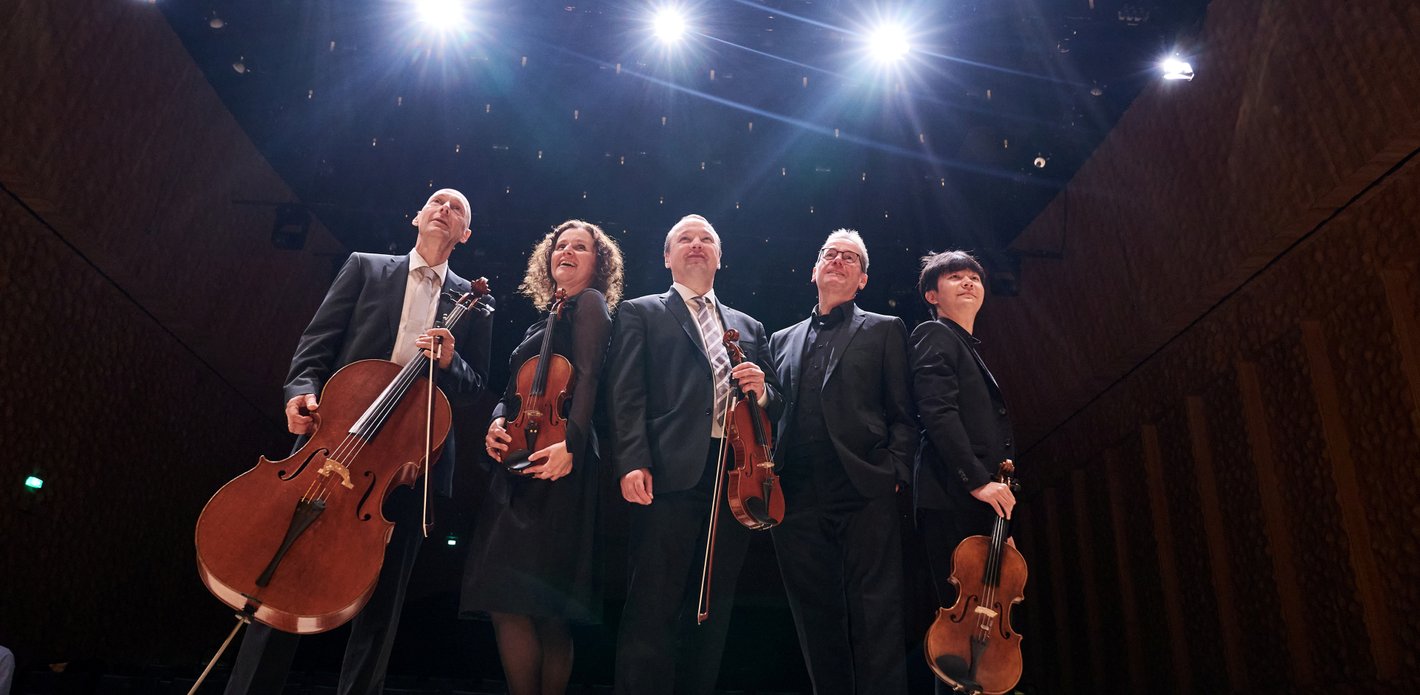
Performers
Daria Pujanek violin
Piotr Pujanek violin
Yitong Guo viola
Arne Klein violoncello
Rupert Burleigh harmonium
Gottlieb Wallisch piano
Programme
Johann Strauß (Sohn) / Alban Berg
Wein, Weib und Gesang / Walzer op. 333
Arnold Schönberg
Presto für Streichquartett C-Dur
Johann Strauß (Sohn) / Arnold Schönberg
Rosen aus dem Süden / Walzer op. 388
Arnold Schönberg
Scherzo für Streichquartett F-Dur
Johann Strauß (Sohn) / Anton Webern
Schatz-Walzer op. 418
– Interval –
Gustav Mahler
Klavierquartettsatz a-Moll
Karol Szymanowski
Streichquartett Nr. 1 C-Dur op. 37
Promoter: Philharmonisches Staatsorchester Hamburg

