Strollers, prams, wheeled walkers, walking-stick umbrellas, bags sized A3 (42 cm x 30 cm) or above, sport bags, backpacks and luggage must be checked in at the cloakroom.
Jackets and handbags may be taken into the hall.
Mozart / Martinů / Bridge / Berg
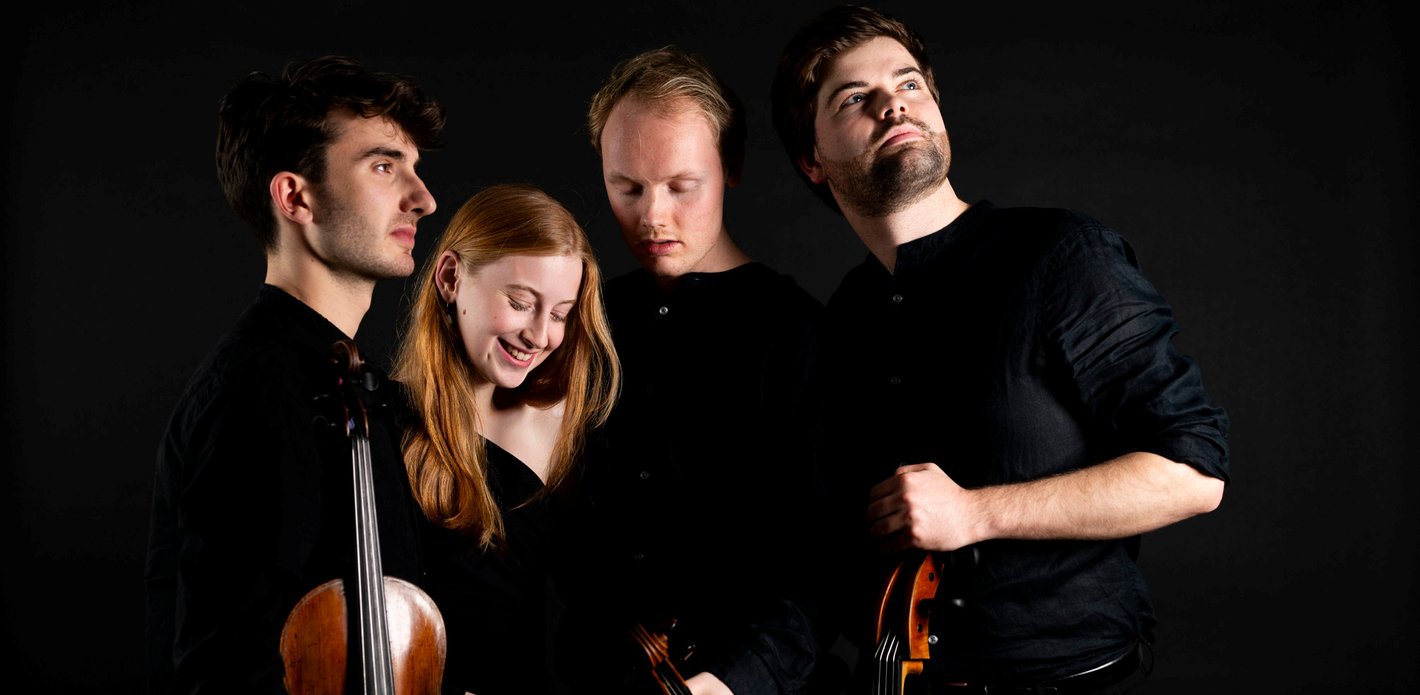
Ein Debüt bei den Hamburger Kammermusikfreunden: Das preisgekrönte Fibonacci Quartet. Benannt nach Leonardo Fibonacci, dem berühmten Mathematiker, der um das Jahr 1200 in Pisa wirkte und erstmalig die Errungenschaften der arabischen Rechenkunst in die europäische Kultur einführte. Visuelles Sinnbild der nach ihm benannten »Fibonacci-Folge« ist die Form der Schnecke, wie sie in der Natur allgegenwärtig ist, aber seit Jahrhunderten auch in der Musik, in der Form des Kopfstücks von Geige, Viola und Cello! Zum aparten Programm in Stichworten: Wolfgang Amadeus Mozarts 1789 geschriebenes Quartett KV 575 gehört zu seinen späten Kammermusikwerken und zeigt seine absolute Meisterschaft im Umgang mit der Gattung. Es ist das erste der drei »Preußischen Quartette«, die er für den Cello spielenden König Friedrich Wilhelm II. komponierte. Erst hier nutzt Mozart voll die Möglichkeiten des (bis dahin?) von ihm nicht überaus geliebten Cellos. Trotz einer zeitweisen Dominanz des Celloparts bleibt die Ausgeglichenheit unter den Stimmen bestehen.
Synkopen und wechselnde Taktarten, perkussive Spielweisen und scharfe Artikulation, abrupte Wechsel zwischen Ruhe und Bewegung prägen Bohuslav Martinůs drittes Streichquartett. Es entstand in Paris, wo Martinů stark von der modernen Musikszene beeinflusst wurde und markiert einen wichtigen Schritt hin zu seinem reifen Stil.
Die drei Idyllen von Frank Bridge sind eher Stimmungsbilder als streng durchkomponierte Sätze. Sanft und ruhig – etwas bewegter – ausdrucksvoll und weit. Die späte Phase von Bridge, später Lehrer von Benjamin Britten, liegt hier noch in der Zukunft. »Moderne« Musik klingt gewiss anders, dieses frühere Werk aus Bridges’ Schaffen ist jedoch nicht weniger interessant und viel zu selten im Konzertsaal zu hören.
Die »Lyrische Suite« von Alban Berg hingegen ist eines der populäreren Werke des frühen 20. Jahrhunderts und eines der bedeutendsten Werke der musikalischen Moderne. Es verbindet emotionale Tiefe mit strenger Kompositionstechnik. In der nach strenger Zwölftontechnik komponierten »Lyrische Suite« sind diverse persönliche Botschaften versteckt. So ist beispielsweise die Satzbezeichnung »Andante amoroso« alles andere als Unabsicht. Und was versprechen Allegro misterioso, Presto delirando oder Largo desolato?
Fibonacci Quartet
Luna de Mol violin
Kryštof Kohout violin
Elliot Kempton viola
Findlay Spence violoncello
Wolfgang Amadeus Mozart
String Quartet in D major, KV 575
Bohuslav Martinů
String Quartet No. 3
– Interval –
Frank Bridge
Three Idylls for String Quartet
Alban Berg
Lyric Suite for String Quartet
19:15 / Laeiszhalle, Kleiner Saal
Friends of Chamber Music / Subscription A
Friends of Chamber Music / Subscription A & B
Kammermusikfreunde Abo A, B & C
Promoter: Hamburgische Vereinigung von Freunden der Kammermusik e.V.
Chamber music series, lieder recitals, children's concerts and jazz events seem to be made for the Recital Hall of the Laeiszhalle, which can accommodate up to 640 guests. (Please note: The Laeiszhalle is a separate concert hall located three kilometres away from the Elbphilharmonie.)
Strollers, prams, wheeled walkers, walking-stick umbrellas, bags sized A3 (42 cm x 30 cm) or above, sport bags, backpacks and luggage must be checked in at the cloakroom.
Jackets and handbags may be taken into the hall.
Facilities for guests of the Recital Hall are located to the right of the hall entrance. Barrier-free toilets are also available.
Laeiszhalle Hamburg
Johannes-Brahms-Platz
20355 Hamburg
The Laeiszhalle can be easily reached by bus, underground and bicycle.
The nearest stops include:
Underground line U2: Gänsemarkt / Messehallen
Underground line U1: Stephansplatz
Bus 3, X35, 112: Johannes-Brahms-Platz
Bus X3: U Gänsemarkt (Valentinskamp)
Bus 4, 5, 109: Stephansplatz
StadtRAD (public city bicycle) station: Sievekingplatz / Gorch-Fock-Wall
There are bicycle stands available in front of the Laeiszhalle.
Gänsemarkt multistorey car park: Dammtorwall / Welckerstrasse
Rate per hour or part thereof: €4.50
24-hour rate: maximum €50
Please note: There are several construction sites in the immediate vicinity of the Laeiszhalle which may make it difficult to get to the concert. Please therefore plan enough time for your journey to the concert.
The Laeiszhalle is a separate concert hall located three kilometres away from the Elbphilharmonie.
We suggest visitors arrive at the Laeiszhalle main entrance not later than 30 minutes before the start of the concert or event. Late seating is not guaranteed and latecomers may not be admitted to the concert hall.
The entrance of the Recital Hall is located on Gorch-Fock-Wall.
Admission times Grand Hall and Recital Hall:
Events without pre-concert talk:
Foyer: 60 minutes before the start of the event
Hall: 30 minutes before the start of the event
Events with pre-concert talk:
Foyer: 90 minutes before the start of the event
Hall: 15 minutes before the start of the talk
If a pre-concert talk is offered for this event, it is noted above under PROGRAMME.
All halls and spaces are accessible for visitors with disabilities. More information at www.elbphilharmonie.de/en/accessibility.
Photography is permitted at the Laeiszhalle for private purposes only. Please respect the privacy of other visitors and help ensure an undisturbed concert experience for all guests and artists. Employees and artists may not be photographed.
Photography, audio or video recordings of concerts and events are strictly prohibited.
Event-related video recordings or photographs for editorial or commercial purposes must be authorised by the Press Office of the Elbphilharmonie and Laeiszhalle.
Saved Events
Login required. If you do not have an Elbphilharmonie customer account, registering is quick and easy.